Cairo
•
IST
2024 — present · Enterprise UX · Internal platform · Microsoft
Cloud Accelerate Factory: Microsoft
The internal portal and the executive reporting system behind Microsoft's Cloud Accelerate Factory: where thousands of in-flight Azure migrations are tracked, aligned to one process, and reported up to leadership.

CLIENT
Microsoft Azure
Duration
2 yrs+ · ongoing
TEAM
Sole designer. I owned the UX end to end, partnering with the Program Director and the program's SMEs, SAs and PMs.
Deliverables
Internal tracking portal (FDO) · Hi-fi UI · Executive dashboard design library · Data visualization
17+
workloads
1,000+
Azure customers impacted
$XXX Mn+
Portfolio reported
Dec 2024
Shipped · 1 yr+ live
Some details are withheld under NDA to protect company information. Everything shown here is shared with permission — figures are redacted, screenshots are cleared. The focus is the design process.
The ecosystem
LTIMindtree is Microsoft's Cloud Migration execution partner. Every Azure customer modernizing the infrastructure they run on Azure across 17 workloads submits their migration request to LTIMindtree, where our migration engineers and workload experts carry it out at par with Microsoft's own delivery and best-practice standards.
The client
Microsoft
Owns every Azure migration initiative — the global ecosystem and primary stakeholder.
The partner
LTIMindtree
Authorized by Microsoft to conduct migrations on its behalf.
The engine
MCAF
A 1000+ person unit inside LTIMindtree built for high-volume migration. FDO lives here.
The beneficiary
Azure customers
Global enterprises receiving direct migration support from the Factory.
PART 1
FDO · FACTORY DASHBOARD & OPERATIONS
GOAL
A consolidated platform to track, report on and unblock Azure migrations carried across 17 workloads as multiple parallel workstreams, for 1,000+ Azure customers.
How it started
A recent partnership, growing fast and the tracking couldn't keep up.
The partnership was new and scaling quickly. The Cloud Accelerate Factory kept expanding the workloads it supported for Azure migrations, and the volume of migrations rose with it.
When the program started, the team tracked and reported the process to leadership in Azure DevOps. Past a certain scale, that tool became too cumbersome, too manual and too rigid to track on. The team needed a robust source of truth - one that would minimize manual errors and reporting delays.
PAIN 1
Manual ACR forecasting
Revenue was calculated manually individually for each workpiece — slow and error-prone
PAIN 2
Fragmented information
Workflows were in Azure DevOps, blockers handled in Teams, and progress in spreadsheets - fragmenting information and reducing ownership visibility.
PAIN 3
A generic tool, a specific job
Azure DevOps treats every item the same so urgency (blockers) and value (ACR) never rose to the surface.
DESIGN process
A 'reactive' project so the process had to be reactive too.
This wasn't a tidy brief I could research, scope and hand off. The Factory was scaling on the ground in real time, and the app had to keep pace. So I treated the design process as a living response to a moving need — synthesizing three very different streams of input rather than waiting for a finished spec that was never going to arrive.
Given input
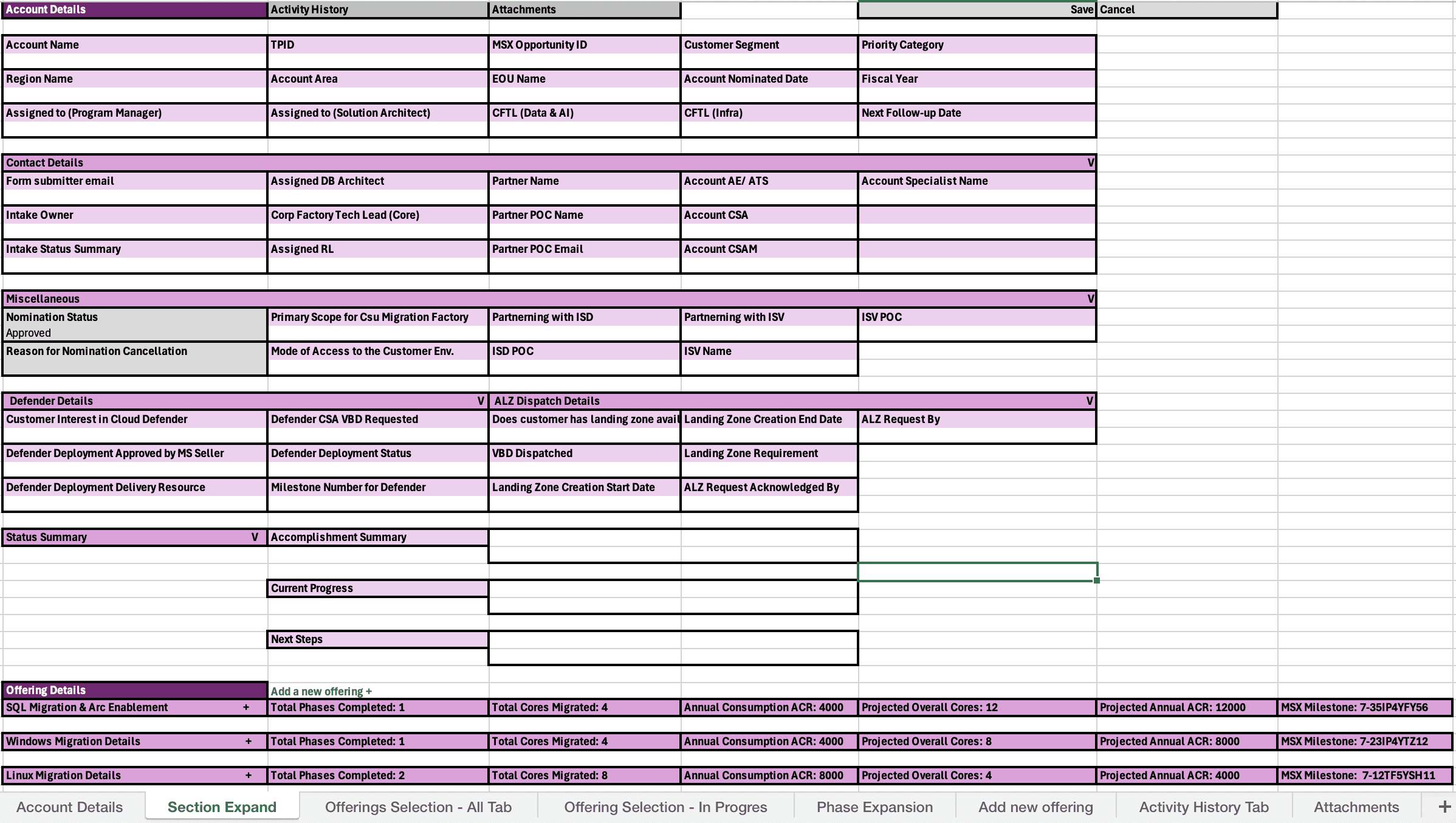
A pre-built Excel PRD
I was handed a requirements doc, an extract of every MVP data field we knew for certain had to migrate from Azure DevOps into the new app. This was the fixed floor: the non-negotiable scope.
Emergent input
A stream of ad-hoc requests
The moment we started translating that spec into design, new asks surfaced - features and functionalities the new platform could now enable that DevOps never could. The scope kept growing as people saw what was possible.



Investigative input
A heuristic audit of Azure DevOps
I ran a heuristic analysis of the existing DevOps setup to map how tracking actually worked today and to gauge the learning curve the new app would have to overcome to feel like an upgrade, not a relearn.
DESIGN process
Designed shoulder-to-shoulder with the Program Director.
With no direct line to a pool of end users, the closest collaborator became the Program Director. Much of the work was translating his mental model of what migration tracking should look like, which factors actually matter, what leadership needs to see - into structure and screens. We ran continuous working sessions, iterating on the design together rather than designing in isolation and presenting back.
DESIGN process
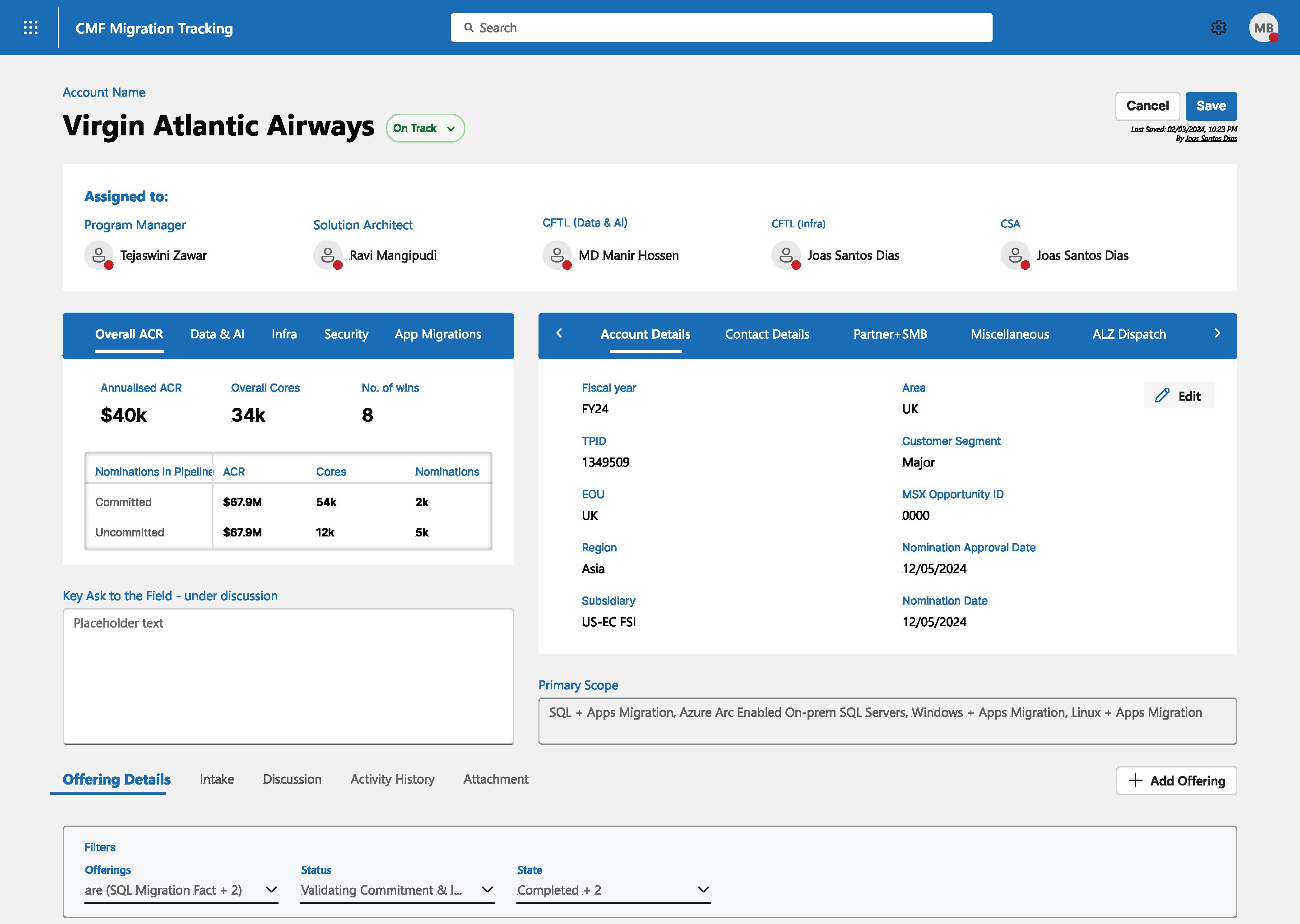
Limited preview
The redesign collapses the tab-switching: an account's status, owners, offerings and blockers read top-to-bottom on a single page, with ACR surfaced where decisions get made.

OUTCOME
FDO became the Factory's day-to-day source of truth for tracking and forecasting across 17 workloads and 1,000+ global accounts, replacing the manual DevOps trackers it was built to retire, and live in production for over a year.
70%
less manual data entry
Automated capture replaced re-keying across dozens of fields per migration.
60%
faster blocker resolution
Surfacing urgency and aligning the team on one process
Automated
pipeline forecasting
ACR now rolls up for leadership without an analyst stitching spreadsheets.
PART 2
EXECUTIVE DASHBOARDS · INFORMATION DESIGN
The brief
The same pipeline, told to leadership
Leadership at both Microsoft and LTIMindtree steer strategy from Power BI dashboards. The existing ones lacked visual consistency and showed raw numbers instead of pipeline status — making project health hard to read at a glance.
What I did
A Power BI design library
I led the information design: a Figma component library that standardized status indicators, chart styles and layout rules that every current and future Power BI report is built on, then trained the developers to implement it in Power BI.
Preview not available
The executive dashboards carry live pipeline and revenue figures for the whole portfolio. This data is highly sensitive - the dashboards themselves can’t be shown here.
PART 3
AGENTIC AI PRE-SALES POD
The brief
From tracking the work to discovering what agents to build for the customer
My current focus inside CAF: an Agentic-AI pre-sales pod for EMEA. Rather than building the agents myself, I’m in front of customers: running discovery conversations to understand what agents they envision, the problems they want solved, and how the program can help build them. What began as a ~10-person customer-acceleration initiative has scaled into a formally recognised internal program.
·
UP NEXT